AI and Brand Strategy
Before you ask what AI can do for your marketing, there is a harder question to answer:
What should your brand stand for?
That question has become more important, not less, as AI becomes more capable and adopted.
McKinsey’s State of Marketing Europe 2026 provides an interesting signal. In its survey of 500 senior marketing decision-makers across France, Germany, Italy, Spain and the UK, branding ranked as the number-one marketing priority for 2026. Leaders particularly emphasised distinctiveness, clear value perception and creativity.
Generative AI and agentic AI, meanwhile, ranked 17th out of 20 priorities. Yet AI is hardly being ignored: half of the CMOs surveyed placed generative-AI-enabled marketing among their three fastest-growing areas of investment.
Source: McKinsey (2025). Past forward: The modern rethinking of marketing’s core
At first, that may look contradictory.
It isn’t.
Businesses are investing rapidly in AI while rediscovering the importance of the strategic fundamentals that give all this new capability direction.
I have argued for years that it should be brand first and then marketing execution: work out what you want your brand to stand for, then take that into your marketing, advertising and the other touchpoints through which people experience your brand.
AI does not change that principle.
It makes the sequence even more important.
Clarify: AI capability is not brand strategy
Artificial intelligence can already help businesses research markets, analyse data and customer preferences, generate ideas, produce and adapt content, personalise communication, evaluate alternatives and increasingly execute more complex workflows.
We should use it.
The mistake is to confuse greater capability with greater strategic clarity.
That is a strategic thinking problem before it is a technology problem.
Imagine a business that has never properly answered some basic brand questions:
What should we be known for?
Who are we trying to matter to?
What authentically differentiates us?
What do we want customers to associate with us rather than our competitors?
What should people experience consistently when they deal with us?
AI cannot make those questions unnecessary.
It may help us investigate them. It may challenge our assumptions, analyse research, structure workshops or test alternatives. But the organisation still has to make and own the strategic choices.
That distinction matters.
I separate strategic brand identity from visual brand identity. Strategic identity is not the logo, colours or fonts. It is what the organisation intends the brand to stand for. My approach is to work through the relevant elements and ultimately whittle them down to a small number of core brand associations—usually one to three—that can give the organisation focus.
Only then does it make sense to ask how the logo, website, customer experience, advertising, social media and/or AI should help reinforce those associations.
So Brand First. Then AI. does not mean AI last.
It means strategy before AI-enabled accelerated execution.
AI can improve the work and still increase the risk of sameness
There is another reason this matters.
A 2024 Science Advances experiment by Anil Doshi and Oliver Hauser already examined what happened when people used generative-AI ideas while writing short stories.
The results are worth paying attention to because they are not conveniently pro- or anti-AI.
People who had access to AI-generated ideas produced stories that were rated as more creative, better written and more enjoyable, particularly among the less naturally creative writers.
But there was a trade-off.
The AI-assisted stories were also more similar to one another than stories produced without AI assistance. Individual performance improved while collective novelty narrowed.
Source: Doshi & Hauser (2024). Science Advances, Generative AI enhances individual creativity but reduces the collective diversity of novel content
We should also not overstate what this proves. The research involved short-story writing, not brand management. It certainly does not demonstrate that every business using AI will become indistinguishable from its competitors, but there is a real danger.
More recent research also suggests that homogenisation is not inevitable. A 2026 experiment found that deliberately giving participants diverse AI personas and inputs could preserve much of the diversity found in human-only output. The researchers argue that some homogenisation may result from uniform ways of deploying AI rather than from an unavoidable limitation of the technology itself.
Source: Computers in Human Behavior: Artificial Humans (2026). Diverse AI personas can mitigate the homogenization effect in human-AI collaborative ideation.
That qualification is important.
The strategic problem is not simply that AI produces sameness.
It is that when organisations use increasingly similar capabilities without sufficiently differentiated strategic inputs, producing competent but undifferentiated work becomes very easy.
McKinsey made a related observation after Cannes Lions 2026. It described concern about “mediocrity at scale” as execution becomes easier to commoditise, and argued that originality, judgement, authenticity and unmistakable positioning consequently become more important.
Source: McKinsey (2026). The real signals from Cannes Lions
This takes us back to differentiation.
When everyone gains access to increasingly powerful execution capability, the capability itself becomes a weaker source of competitive difference.
What you ask that capability to reinforce becomes more important.
Focus: AI requires stronger brand strategy guardrails
AI dramatically expands what organisations can do.
That does not mean they should do all of it. Especially smaller businesses.
This is where brand strategy becomes a useful management discipline rather than being confused with a marketing document.
Let’s take a simple example.
A coffee shop could run an AI-assisted campaign around being the cheapest coffee shop in town, this week. Next week it could produce a beautifully designed campaign about premium quality coffee. The week after that, AI could generate a compelling customer-service campaign positioning the business around warm personal relationships.
Each campaign could be individually excellent.
Collectively, they could still leave the customer asking:
What exactly is this brand about?
The problem is not the quality of the AI output.
The problem existed before the AI received the prompt.
The business had not made a sufficiently clear strategic choice.
Brand strategy deliberately reduces possibilities. It establishes what deserves focus.
- these are the customers we particularly want to serve;
- this is what authentically differentiates us;
- these are the few associations we want to build;
- this is the personality with which we want to show up;
- these values should influence how we behave;
- these choices are on-brand; and
- these choices are not.
There is an important implication here.
As AI expands capability, the value of meaningful strategic constraints increases.
That is not an argument for putting AI in a straitjacket. It is an argument for giving both people and technology better context.
Generic context produces generic options.
Distinctive strategic context gives AI something more useful to work with.
The question therefore shifts from merely:
How do we write better prompts?
to:
What strategic context are we giving AI before we prompt it?
Focus your people and your AI on the same brand
This should not become another technology project owned exclusively by marketing.
Employees also need to understand what the brand stands for.
I have long argued, with the Brand for Success Process, that once the brand has been clarified, the next step is to focus the team around it. The people making daily decisions need a simple enough understanding of the brand to ask:
Does this support what we are trying to stand for?
Is this on-brand?
What would the brand require us to do here?
AI now needs much of the same context.
That does not mean copying a 70-page brand guideline into every AI system.
In fact, the traditional brand guideline may be part of the problem if it concentrates mainly on logo placement, colours, fonts and brand voice.
Those things matter, but they are downstream.
An AI system can follow the right colour palette and still help produce something strategically off-brand.
The more useful guardrails begin further upstream:
Who are we? Who are we for? What makes us meaningfully different? What do we want to stand for? What must remain consistent even when the execution changes?
Those are brand-management questions before they are AI questions.
Align: AI integration should strengthen the brand, not simply produce more content
The AI-and-brand conversation is often reduced to content creation.
But AI integration into brand management should go much further than content production.
Can AI write our posts?
Can it create an image?
Can it produce advertisements?
Can it rewrite our website?
Those are useful applications, but they are a narrow view of the opportunity.
AI can also help organisations examine whether what they are already doing is aligned with what the brand is supposed to stand for.
I have used precisely this sequence in Strategic Brand Management teaching.
Students first work through the brand strategy and identify the core associations the brand ideally wants to stand for. Only after that strategic work do they use an AI-enabled brand-management application to evaluate individual brand touchpoints against those associations and identify opportunities for better alignment.
The sequence matters:
Clarify the brand → define the core associations → evaluate execution against them → improve alignment.
To apply this thinking to an ordinary business:
Suppose a professional-services firm has decided that it wants to be known particularly for clarity, commercial practicality and personal senior-level involvement.
Those associations create criteria.
An AI-assisted proposal can be evaluated against them.
So can the website.
So can a sales email.
So can the client onboarding process.
So can the way a telephone call is handled.
So can the reports delivered to clients.
So can the customer-service chatbot.
The point is no longer merely, “Did AI produce something impressive?”
The question becomes:
Did this reinforce the brand we have deliberately chosen to build?
That is a much more useful test.
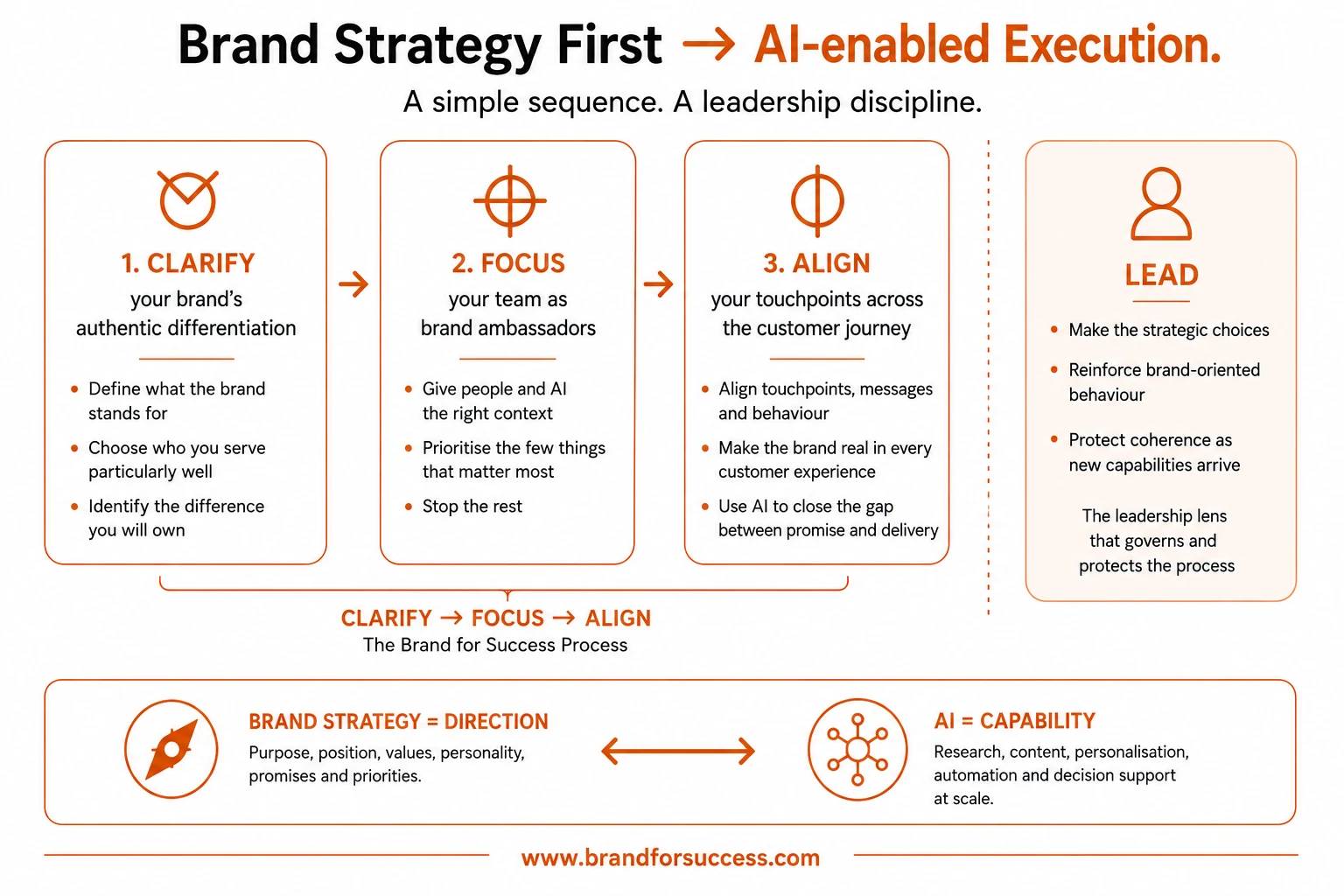
Put simply, brand strategy provides the direction; AI provides the capability. The leadership task is to keep the two aligned.
Alignment goes beyond marketing
This is also why brand should not be confined to the marketing department.
Brand orientation research treats the brand as a strategic organisational concern. In research I co-authored on South African retailers, brand-oriented values, norms, symbols and behaviour formed part of the organisation’s ability to build and live a clear identity, with brand-oriented behaviour and symbols showing significant relationships with market performance in the study.
Let’s translate that; the practical point is straightforward.
Customers do not experience your marketing department.
They experience the business.
They experience the product, people, service, processes, website, environment, communication, problem-solving and follow-through.
Increasingly, AI may influence many of those touchpoints.
That makes alignment more, not less, important.
An organisation can automate inconsistency just as effectively as it can automate consistency.
The real opportunity is to use AI to help close the gap between what the brand promises and what the organisation repeatedly delivers.
Lead: the strategic choice cannot be outsourced
There is a leadership issue underneath all of this.
AI makes it increasingly easy to generate alternatives.
Leadership is still responsible for making choices.
AI implementation therefore requires leadership choices, not merely technical capability.
What do we want this organisation to stand for?
Which customers are we choosing to serve particularly well?
Which difference are we prepared to build, invest in and protect?
What will we stop doing because it weakens that focus?
Which behaviours must our people reinforce?
Where can AI genuinely improve the experience?
Where does human judgement remain important?
How will we know when execution is moving away from the intended brand?
These are not prompt-engineering questions.
They are leadership questions.
And they involve trade-offs.
A brand that tries to stand for quality, innovation, lowest price, exclusivity, accessibility, speed, personal service, sustainability and everything else simultaneously will struggle to stand for much at all; as the late legendary marketing strategists Jack Trout and Al Ries have been telling us since 1980.
AI can generate a plausible argument for every option.
Leadership still has to decide.
That is one reason I treat brand as a leadership discipline.
Leaders do not need to personally write every advertisement or approve every AI-generated email. In an organisation using AI at scale, that would become impossible anyway.
Their responsibility is more important than that.
They need to create sufficient strategic clarity that other people, and increasingly the systems assisting those people, can make better decisions without constantly returning to the top for approval.
That is how brand clarity becomes a decision system.
Brand first is becoming more important, not less
AI will keep improving.
It will become more deeply embedded in research, marketing, customer experience, operations and decision-making. Trying to compete by refusing to use it would make little sense.
But neither should leaders mistake increased execution capability for strategy.
The central question remains remarkably stable:
What do we want this brand to stand for?
Clarify that.
Then focus your people and technology on the few things that really matter.
Then align what customers see, hear and experience with those choices.
And lead the organisation strongly enough to protect that coherence as new capabilities arrive.
Frequently Asked Questions
Can AI create a brand strategy?
AI can support brand strategy by helping with research, analysis, idea generation, workshop preparation and the evaluation of alternatives. But it cannot remove the need for strategic choice. Leaders still have to decide what the brand should stand for, who it should matter to and which differences the organisation is prepared to build and protect.
How should AI be used in brand strategy?
Use AI within a clarified brand strategy, not instead of one. Give AI the same strategic context that should guide people: the target audience, authentic differentiator, core brand associations and relevant brand guardrails. Then use AI to improve research, execution and alignment across brand touchpoints.
How can brands avoid becoming generic when using AI?
The risk increases when organisations use similar AI tools with generic inputs. The answer is not to avoid AI, but to give it more distinctive strategic context. A clearly differentiated brand gives both people and AI something specific to reinforce, making consistent but undifferentiated output less likely.
AI increases what a business can do.
Brand strategy helps determine what it should do consistently and distinctively.
That is why the sequence matters.
Brand first. Then AI.
Before your next AI initiative, ask one question: what exactly should this technology help your brand reinforce?
If the answer is not yet clear, start with the Brand for Success Process: Clarify what authentically differentiates your brand, Focus your people on what matters most, and Align the customer experience around it.